


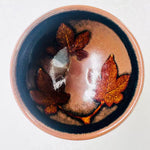
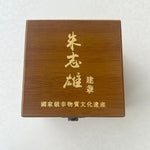
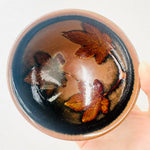
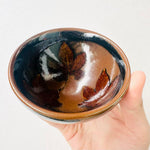
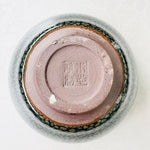
measurements:
diameter:8cm
height:4cm
【Partridge Feather】
· Appearance: Speckled or mottled patterns similar to the plumage of a partridge bird.
· Difference from oil spot: These spots are usually smaller, denser, and less perfectly circular — sometimes blurred or layered.
· Example: A bowl covered in tiny overlapping brown and silver speckles, reminiscent of wild bird feathers.
-----
【wood fire with leaf】
The "Wood Leaf Tea Bowl" – is one of the most poetic and mysterious treasures in Chinese ceramic history. Originating from the Jizhou Kilns of Jiangxi Province during the Southern Song Dynasty (1127–1279) , these tea bowls capture a single natural leaf forever within a pool of dark, luminous glaze .
Legend tells that one day, as potters were loading their kilns outdoors, a few autumn leaves accidentally drifted onto the unfinished vessels. When the kiln was opened, they discovered that the leaves had not burned away. Instead, they had left behind ghostly, golden imprints – their veins perfectly preserved, as if frozen in time . This happy accident became the foundation of one of China's most revered ceramic arts.
---
The Process:
1. A single natural leaf – traditionally mulberry or bodhi leaf – is selected and treated
2. The leaf is carefully placed onto a tea bowl coated with dark Tenmoku glaze
3. The bowl enters the kiln and is fired at temperatures exceeding 1200°C (2192°F)
4. At this extreme heat, the leaf's organic matter completely burns away to ash
5. The ash chemically bonds with the iron-rich glaze, leaving behind a permanent, ethereal imprint of the leaf's veins and silhouette
No paints. No brushes. No carving. Just fire, chemistry, and a single leaf that refused to disappear.
---
The beauty of the leaf
The true wonder of a Wood Leaf Tea Bowl reveals itself only when you pour tea inside.
As the dark liquid fills the bowl, the golden leaf seems to lift from the bottom and float just beneath the surface – a tiny boat drifting across a night-black sea . Tilt the bowl, and the leaf dances with the tea. Hold it still, and it rests quietly at the bottom, waiting.
Every bowl is completely unique. Just as no two leaves in nature are identical, no two Wood Leaf Tea Bowls can ever be the same. This is why it is said:
"Among leaves, there are no pairs. Among bowls, each is one of a kind."
---
Meaning of the leaf:
For Buddhist monks and tea masters of the Song Dynasty, the Wood Leaf bowl carried deep spiritual resonance.
The mulberry leaf – connected to China's ancient silk culture – symbolizes the essential bond between nature and human livelihood . The bodhi leaf, sacred to Buddhism, represents the moment of enlightenment beneath the Bodhi tree .
One Zen interpretation sees the leaf as a metaphor for transcendence – a fallen, dying leaf passing through the kiln's thousand-degree fire and emerging reborn, immortal, and beautiful. A quiet reminder that even in death, there is beauty. Even in ending, there is transformation .
---
【Wood-Fired】
Jian Zhan refers to Jian tea bowls fired in a traditional dragon kiln using pinewood as fuel, following the ancient Song Dynasty method. Unlike modern gas or electric kilns, wood firing is a natural, unpredictable process that produces unique, unrepeatable results.
---
Key Characteristics of Wood-Fired Jian Zhan
1. Natural Ash Glaze
During firing, wood ash lands on the bowl's surface and melts at high temperatures (around 1300°C), forming a natural glassy layer. This creates flowing, uneven textures that are impossible to replicate artificially.
2. Fire Kiss Marks
The flames directly touch the pieces, leaving orange-reddish or greyish-blue scorch marks on one side. These "flame trails" are highly prized as they show the kiln's raw energy.
3. Unique Crystal Patterns
The slow temperature changes and natural reduction atmosphere produce deeper, more rustic colors than gas-fired wares.
4. Subtle, Earthy Colors
Without chemical additives, wood-fired Jian Zhan displays muted blacks, dark browns, rust reds, and olive greens – a quiet, aged beauty.
---
How It Differs from Gas/Electric Fired Jian Zhan
| Electric Fired | Wood-Fired Gas | |
| Fuel | Pinewood (3–5 days continuous) | Gas or electricity |
| Kiln atmosphere | stable | Wild, uneven reduction Controlled |
| Finish | Natural ash + flame marks | Clean, predictable glaze |
| Pattern | Flowing, rustic | Sharp,vibrant |
| Yield rate | Very low (~20–30% success) | High (over 80%) |
| Rarity | rare | Common |
---
Why Is Wood-Fired Jian Zhan Special?
· Each piece is one of a kind – no two bowls are ever identical.
· It captures the spirit of Song Dynasty kilns – the same ancient technique used for imperial tea bowls.
· The "uncontrolled" beauty – imperfections like ash spots, flame scars are considered artistic expressions of fire and wood.
· Collector's treasure – wood-fired Jian Zhan is much rarer and more expensive than modern fired wares.
---
Care Tips for Wood-Fired Jian Zhan
· No special opening ceremony needed – just rinse with water.
· Use for tea daily – over time, tea stains will settle into the natural texture, enhancing its rustic charm.
· Never use detergent – the porous surface absorbs flavors. Rinse only with clean water.
-----
Note: As with all handmade pottery, slight variations in size, glaze pooling, and shape are marks of authenticity—not defects.
#jizhou kiln woodfire partridge leaf brown
Lorem ipsum dolor sit amet, consectetur adipiscing elit. Duis vulputate, lectus ac pretium maximus, magna neque fermentum arcu, ut pulvinar arcu erat vel massa. Pellentesque ac arcu blandit, vestibulum tortor eget, dictum magna. Curabitur sit amet metus nulla. Pellentesque et augue et urna volutpat vestibulum vitae eget ligula. Maecenas mi augue, faucibus scelerisque facilisis in, dignissim vitae justo. Sed venenatis lectus et leo malesuada iaculis. Nunc lacinia arcu id elementum rhoncus. Duis tempor, enim vel vulputate interdum, magna sapien lacinia enim, nec lobortis quam enim eu erat. Aenean faucibus ex vitae nibh accumsan ullamcorper. Sed a orci augue. Maecenas porttitor venenatis semper.
Lorem ipsum dolor sit amet, consectetur adipiscing elit. Nulla luctus libero quis mauris vestibulum dapibus.
Maecenas ullamcorper erat mi, vel consequat enim suscipit at. Pellentesque a elit at elit
-
Lorem ipsum dolor sit amet
Maecenas ullamcorper erat mi, vel consequat enim suscipit at.
-
Quisque in felis ut tellus
Pellentesque a elit at elit auctor tempus sed vitae mi
-
Morbi blandit auctor
Vestibulum sollicitudin tortor dui, quis aliquet sapien convallis sed.
-
Sed sit amet risus quis velit lacinia gravida.
Aenean interdum elementum arcu. Vivamus purus lorem, semper quis libero et.
-
Morbi dictum orci neque.
Curabitur vehicula tellus sit amet neque placerat, vel sagittis.
Product Related


Recently Viewed Products